After the Last Train: Sleep, Shift Work and the Small Hours Beneath a Third Runway
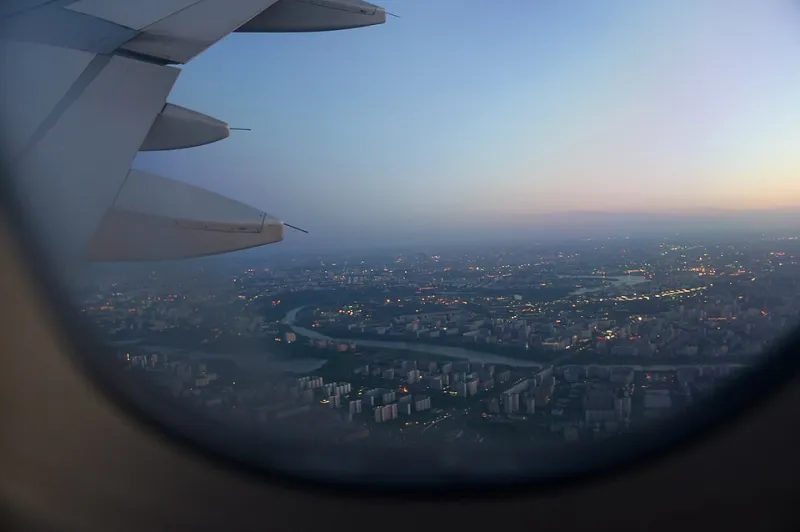
Photo: Vyacheslav Argenberg, CC BY 4.0, via Wikimedia Commons
Every night, between eleven and six, several hundred thousand people live beneath the flight paths that converge on Heathrow. The airport's noise contours describe this as an area of significant community annoyance. What the contours cannot describe is a four-year-old waking at twenty to five because the arrivals stream has shifted a few hundred metres west, or the way a district nurse in Cranford begins her third consecutive shift on five hours of broken rest.
This is a story about the gap between the model and the bedroom.
The contours, and what they average away
Official night-noise maps rest on a statistical compromise. They average aircraft noise across the whole night period, then draw a line around the places where that average crosses a threshold. The line is genuinely useful for planning. It is not a description of what anyone actually hears.
A single wide-body on final approach at two in the morning produces a sound event that a sleeper experiences as an interruption. Averaged across eight hours, that interruption becomes a decimal place. For a decade, industry figures have presented night noise as broadly stable. That claim depends heavily on the chosen metric. The argument ought to sit with awakenings — the number of times sleep is actually broken — and with the second-order effects that follow: concentration in classrooms, error rates on night shifts, blood pressure, the low-grade irritability that accumulates across a week of poor rest.
The case for expansion rests on the proposition that a third runway can be delivered within existing noise limits. What that proposition conceals is the redistribution of the small hours. Additional capacity means more early departures and more late arrivals. A quota regime can hold the annual total steady on paper while shifting the burden onto streets that have, until now, enjoyed a partial reprieve.
Three roads after dark
Heathrow Pause has spent the autumn gathering accounts from households in Hounslow, Slough and Windsor. They are not a scientific sample. They are a reminder of what the spreadsheets are measuring.
In Hounslow, a paediatric nurse described the rhythm of her week: asleep by nine, awake at half past four, on the ward for six. The first departure wave crosses her street before her alarm does. She has rerouted her walk to work along a quieter road, and she has stopped noticing that she has stopped noticing. In Slough, a driver on a twilight delivery round said the difficulty is not the volume of any single aircraft but the unpredictability — the sense that the night no longer has a reliable quiet core. In Windsor, a retired teacher keeps a pencil log of nights when the noise woke her. She has filled two notebooks since 2023, and her GP has noted environmental sleep disruption in her records at her request.
None of these people is asking for silence. They are asking for a night that has a shape.
Schools, shifts and the arithmetic of a bad night
Sleep loss is not distributed evenly. It follows the night economy: cleaners, carers, baggage handlers, hospital staff, bakers, warehouse pickers. These are the workers least likely to have acoustic glazing, mechanical ventilation or the option of moving. A ward-level assessment of a third runway should begin with their shift patterns, not with an average decibel reading attached to a postcode.
The same holds for schools. A child woken twice a night does not arrive in a reception class ready to learn. Teachers in Hounslow primaries describe the Monday-morning effect, and a sharper version of it in winter, when night flights and sealed windows coincide. Attainment gaps are rarely attributed to aircraft, but the mechanisms are well documented in the public health literature: chronic partial sleep restriction, elevated cortisol, degraded attention.
Why the metrics matter to the campaign
Where a debate is conducted on averages, expansion wins by default, because averages are designed to absorb precisely the harms residents describe. The task for campaigners in 2026 is to insist on measures that reflect lived experience: awakenings per night, the timing of the first and last movement, the proportion of the night that is genuinely quiet, and the number of households inside a contour drawn tightly enough to mean something.
Where an operator declines to publish those figures, they can be requested. Where they are published at an aggregation level that hides street-level effects, they can be challenged. A pause is not a refusal to look at evidence. It is a demand that the evidence be adequate to the decision being taken.
What a genuine pause would require
A pause on expansion need not be indefinite and should not be vague. It can be defined with precision: no development consent order should progress until an independent night-noise assessment, using awakening-based metrics and postcode-level modelling, has been published and consulted upon; until the air-quality and traffic modelling underpinning the scheme has been independently reviewed; and until local authorities have had a proper opportunity to test the proposals against their own health and planning evidence.
That is an achievable demand, and a democratic one. People who will live beneath the flight paths have a reasonable expectation of seeing the workings.
The night as a public good
There is a strand of policy thinking that treats the night as spare capacity — hours available for economic use if only the objections can be managed. Communities under the approach paths take a different view. For them the night is the last shared resource, the period in which a city is quiet enough for the people who keep it running to recover.
Heathrow Pause will keep publishing what residents send us, in pencil and in email, and will keep pressing for numbers that match the experience. If the case for a third runway cannot survive an honest account of a single night over Hounslow, it should not be waved through on the strength of a twelve-month average.
Sleep is infrastructure. It is time the planning system treated it that way.