The Uninsurable Neighbourhood: What Underwriters Might Read Into a Third Runway

Every expansion case arrives with a thick volume of projections: passenger numbers, jobs, gross value added, carbon. What it never arrives with is an insurance chapter. Yet for households from Harmondsworth to Stanwell, from Sipson to Datchet, the first financial consequence of a third runway would not be a noise contour or a compensation cheque. It would be a renewal letter.
This is not a prediction that insurers will abandon swathes of west London. It is a call for something more modest and more useful: a proper, public audit of how underwriters, valuers and mortgage lenders might respond to a decade of construction followed by a permanent change in the character of the area — and whether anyone has actually asked them.
What underwriters actually price
Home insurance is not priced on sentiment. It is priced on modelled peril: flood, subsidence, storm, escape of water, fire, theft, and the cost of rebuilding. Industrial and commercial policies add business interruption, plant, premises liability and environmental exposure.
Expansion touches several of these at once. Piling, excavation and heavy plant bring vibration and ground disturbance during construction. New hardstanding, apron and access infrastructure alter drainage and surface-water behaviour across a catchment that already struggles. And the sheer concentration of high-value aviation and logistics activity raises questions about aggregation — the industry term for how much risk an insurer is carrying in one place at one time.
Aggregation matters to residents because it is contagious. If a single postcode district becomes expensive for an insurer to cover in bulk, that cost is recovered somewhere. It is usually recovered through premium, through excess, or through exclusions quietly written into the small print of a renewal.
The construction decade is the insurance decade
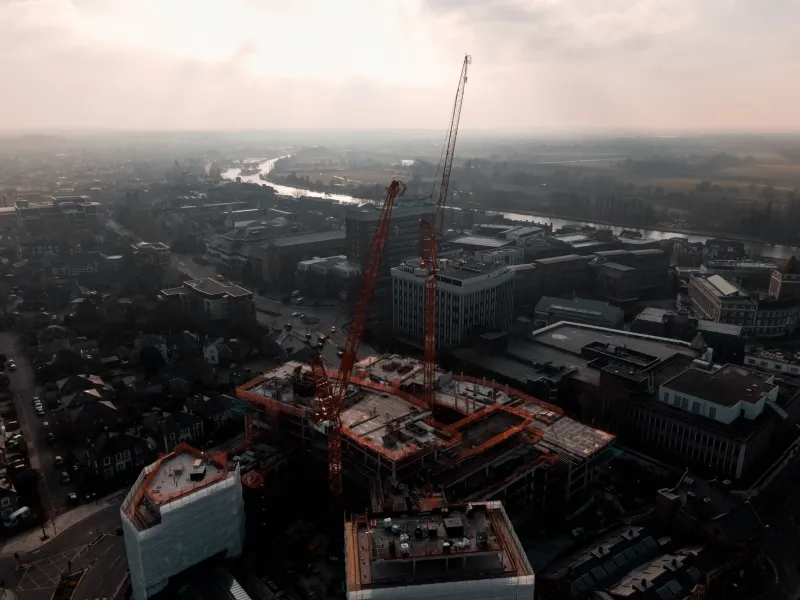
Public debate about Heathrow habitually jumps to the operational phase: the aircraft, the contours, the night flights. But a third runway would be built first, over years, with all that entails. Residents would live alongside earthworks, haul routes and compound lighting long before the first arrival.
During that period, three insurance questions deserve straight answers. First, how would construction-phase vibration affect claims for cracking and subsidence on older housing stock, much of it built before modern foundation standards? Second, would insurers apply construction exclusions or increased excesses to properties adjacent to works, and would those terms be disclosed to buyers? Third, who carries liability if damage is disputed — the promoter, its contractors, or the householder's own policy?
The typical resident response to damage is to claim on their own buildings cover, absorb the excess, and lose a no-claims discount. That is a private subsidy of a public project, and it is invisible in any economic appraisal.
Flood, drainage and the Colne
The Colne Valley is not a footnote to this argument; it is central to it. Any additional impermeable surface changes where water goes. Insurers price flood risk using national mapping and their own models, and those models respond to changes in the built environment.
A resident does not need to believe in catastrophe to see the difficulty. They need only ask whether a property currently quoted as moderate risk could be requoted at higher risk once drainage capacity, culverts and attenuation are recalculated around a larger airport footprint. If the answer might be yes, then the expansion case should model it — honestly, publicly, and at property level, not at the level of a regional average.
When a lender hesitates
There is a second, quieter mechanism: mortgageability. Lenders are conservative institutions. They rely on valuers, and valuers rely on comparables and on a view of future saleability. Where a locality faces a long planning process, compulsory purchase uncertainty, or a material change in amenity, valuers can and do attach warning notes. Lenders can respond by shortening terms, demanding larger deposits, or declining altogether.
That matters even for people who never intend to move. A home that is difficult to mortgage is a home that is difficult to sell. It is also a home that is difficult to remortgage at the end of a fixed term. The financial penalty arrives without a planning decision and without compensation, because compensation regimes respond to physical works and to statutory blight designations, not to a valuer's cautious paragraph.
Anyone who has watched the property market around major infrastructure schemes will recognise the pattern. The harm is not uniform, and it is not theatrical. It is a slow widening of the gap between what a house is worth to the family living in it and what a buyer's lender is prepared to advance.
Community buildings and business continuity
Houses are only part of the ledger. Village halls, sports clubs, places of worship and independent businesses carry insurance too, and they carry it on thin margins.
Consider a small logistics firm or a hotel at the airport's edge. Its policy will include business interruption cover, and that cover assumes access. If construction alters roads, closes lanes or makes delivery windows unreliable over successive years, the risk profile of that business changes — and so, eventually, does its premium. Community buildings face a related problem: many are older, some are listed, and rebuild costs for heritage structures are already difficult to place with insurers. Add proximity to major works and the pool of willing underwriters narrows further.
These are the institutions that hold a place together. If insuring them becomes harder, the social cost is not captured in any passenger forecast.
A resident's disclosure checklist
None of this is a reason to panic. It is a reason to be precise. A few practical steps are worth taking now, while the arguments are still open.
- Read your current schedule carefully and note any peril exclusions, not just the headline premium.
- Keep dated photographic records of the condition of your property, inside and out.
- Retain renewal quotations year on year; a premium history is evidence.
- Remember that under the Consumer Insurance (Disclosure and Representations) Act 2012 you must answer your insurer's questions honestly and reasonably — but you are not obliged to volunteer speculative fears about a project that has not been approved.
- If you are buying or remortgaging, ask your conveyancer explicitly about infrastructure blight and about any planning designations affecting the property.
- For businesses, review business interruption wording for access and denial-of-access triggers before, not after, disruption begins.
What we are asking for
The case for a pause is often framed around noise, air quality and climate. All are legitimate. But a pause is also the only moment at which the unglamorous questions can still be asked and answered.
We are asking the promoter to commission and publish an independent insurance and lending impact assessment, covering residential, commercial and community property, at postcode level. We are asking local authorities in Hillingdon, Hounslow, Spelthorne, Slough and Windsor and Maidenhead to press the Association of British Insurers and major lenders for a view on how they would treat the affected area during construction and afterwards. And we are asking that any compensation package be tested not only against market value, but against insurability and mortgageability — the two conditions that determine whether a home can actually be held, or sold, by an ordinary family.
A runway is a decade of disruption followed by a century of consequence. The insurance industry understands long horizons better than most. It is time the expansion debate did too.
Heathrow Pause provides civic analysis, not financial advice. Residents should consult their own broker, surveyor or solicitor about individual policies and transactions.