The Irreversible Layer: Heathrow Expansion and the Heritage That Cannot Be Rebuilt
On the western edge of London, the argument about Heathrow expansion is usually conducted in the currency of noise, carbon and congestion. Those are the measures that dominate consultation documents and council chambers. But beneath the proposed north-west runway zone lies a record that no noise contour can capture and no mitigation package can restore: the physical archive of centuries of human settlement, farming, movement and defence. A third runway is not simply a planning decision above ground. It is an irreversible decision about what lies beneath it.
The ledger beneath the tarmac
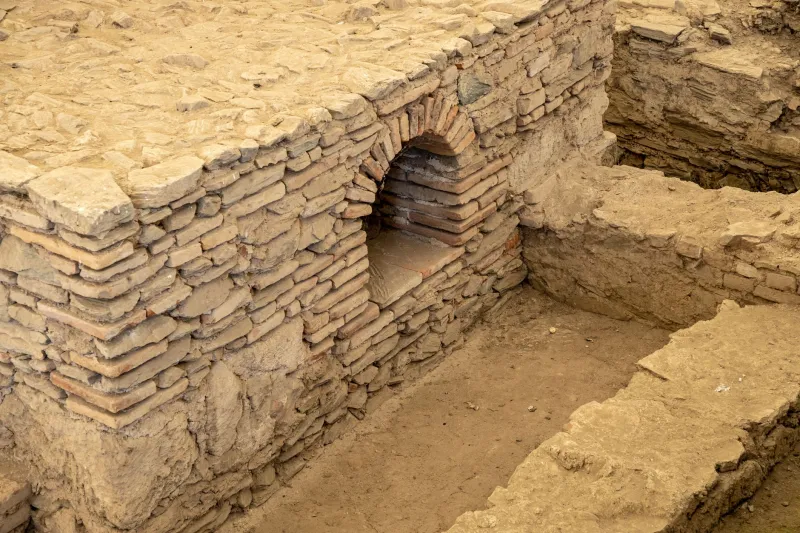
The landscape around Harmondsworth, Longford and the Colne Valley is not empty space waiting for infrastructure. It is a palimpsest. Medieval open-field systems, ridge-and-furrow earthworks, ancient trackways and boundary ditches sit alongside moated sites, farmsteads and the remains of twentieth-century wartime defences. The area's historic character is bound up with the Great Barn at Harmondsworth, listed farm buildings, churchyards and the low-lying water meadows that have shaped settlement for centuries. Elsewhere in the zone, anti-aircraft batteries, dispersal pens and pillboxes recall an earlier era when this land was militarised for the defence of the capital.
Much of this is known. More of it is not. Cropmarks, geophysical anomalies and stray finds in the Historic Environment Record hint at buried deposits that have never been evaluated. In a landscape this heavily used, the absence of a scheduling designation is not evidence of absence. It is evidence that nobody has yet looked closely enough.
What developers must do—and what they need not
Under the National Planning Policy Framework, applicants are expected to describe the significance of heritage assets affected by a proposal, including any contribution made by their setting. In practice, that means an archaeological desk-based assessment, a heritage chapter in the Environmental Impact Assessment, geophysical survey and, where necessary, trial trenching. Statutory consultees such as Historic England and the Greater London Archaeological Advisory Service will comment. Listed building consent and scheduled monument consent may be required where designated assets are affected.
All of this is necessary. None of it is sufficient. The planning system is adept at requiring process; it is far less reliable at guaranteeing outcomes. A developer can satisfy the letter of the framework by commissioning surveys, producing reports and agreeing a written scheme of investigation, while the most significant buried remains are still excavated away. The question for residents is not whether the paperwork exists. It is what the paperwork commits anyone to do.
Preservation by record is not protection
The phrase 'preservation by record' is one of the most reassuring in planning—and one of the most misleading. It means that where remains cannot be preserved in situ, they will be excavated, drawn, photographed and published before construction. The record may be excellent. The archaeology is still destroyed.
That matters for three reasons. First, excavation is not a neutral act: it removes the asset from the landscape and from the communities that live with it. Second, the research questions that shape an excavation are often set by the applicant's consultants, not by the parish or the wider public. Third, archives are not always accessible or permanently curated. A report on a shelf in a planning office is not the same as a landscape that people can walk through, understand and value.
The setting of listed buildings deserves particular scrutiny. A medieval barn or a church tower does not exist in isolation; its significance is partly constituted by the fields, lanes and views around it. If those are removed, the asset survives in law but is diminished in meaning. Heritage impact assessments often treat setting as a matter of visual amenity. It is also a matter of historical relationship.
The questions parish councils should ask in 2026
Any heritage assessment submitted for the expansion zone should be read as a public document, not a technical annexe to be nodded through. Parish councils, residents' associations and local historians can reasonably ask for the following:
- A full Historic Environment Record search, with copies of all known monument records and find spots, deposited in a publicly accessible form.
- A published written scheme of investigation, agreed before fieldwork begins and open to comment from the local authority's archaeological adviser.
- Independent review of the developer's heritage chapter, commissioned by the council and funded by the applicant.
- A condition survey of all listed and locally listed buildings in the zone, including an assessment of setting and curtilage, not just fabric.
- A dedicated survey of twentieth-century wartime remains, which are often undervalued and easily swept away.
- Palaeoenvironmental and geoarchaeological sampling in the Colne Valley, where waterlogged deposits can preserve evidence of past climate, land use and vegetation.
- A legal commitment to preserve in situ any remains of national importance, rather than a default to excavation.
- A public archive and open-day programme, so that residents can see what is being lost before it is lost.
- A heritage condition attached to any consent, requiring sign-off by the local authority's archaeological adviser at each stage.
These are not obstructionist demands. They are the minimum conditions for an informed decision. A campaign for a pause is not a campaign against knowledge. It is a campaign against decisions taken before knowledge has been gathered and tested.
The pause that heritage requires
Noise can be mitigated. Carbon can, in principle, be priced. A runway can be built. But archaeology is a non-renewable resource. Once the tarmac is laid, the medieval field system, the earlier trackway and the unrecorded burial are gone for good. The planning system calls this 'loss'. The better word is erasure.
Heathrow Pause argues for a genuine pause: not a delay to construction, but a pause before consent, in which the heritage of the expansion zone is surveyed, published and debated in public. Residents of Harmondsworth, Longford and the surrounding parishes are not asking to freeze history. They are asking that history be read before it is written over. That is a reasonable request in any year. In 2026, with the expansion case still being assembled, it is also an urgent one.