The Tonnes Beneath the Tarmac: Auditing the Carbon Heathrow Would Spend Before It Flies
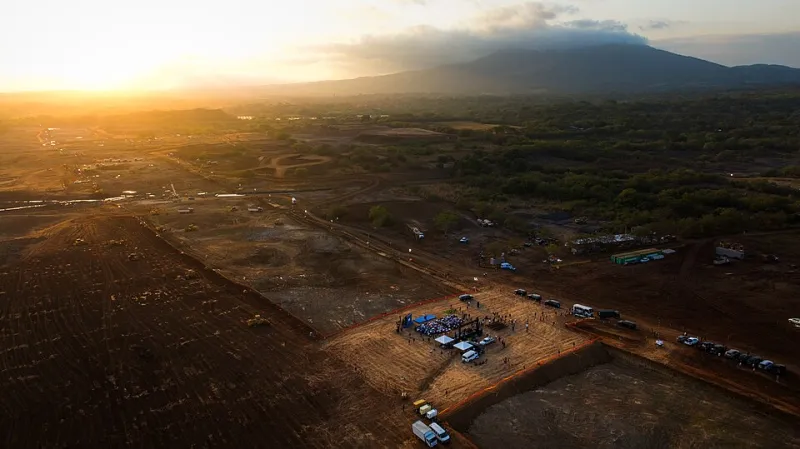
Photo: Casa Presidencial El Salvador, CC0, via Wikimedia Commons
The Heathrow debate has a habit of starting in the sky. Aircraft emissions, sustainable aviation fuel, the chemistry of contrails: these are the terms in which expansion is argued, defended and, increasingly, sold. Yet the first carbon released in the name of a third runway would not come from an engine. It would come from a digger working the clay of the Colne Valley, a cement wagon on the A4, and a batching plant running through the night.
That carbon is rarely counted. It belongs to the construction phase — the pavement, terminals, tunnels, access roads, drained rivers and displaced utilities — and it is spent before the project has carried a single passenger. On any honest reading of the UK's climate commitments, it is the first bill and the least discussed.
A bill that arrives before the first boarding card
Specialists distinguish between operational carbon, which accrues over a building's life, and embodied carbon, which is locked in by making, moving and assembling the materials it is built from. Aviation policy has become fluent in the first and largely silent on the second. Expansion documents speak of efficient aircraft and cleaner fuel; they say rather less about the several hundred thousand cubic metres of concrete required to lay a runway across a floodplain.
The omission is not accidental. Embodied carbon is awkward for a growth case because it cannot be deferred, traded or blended. It lands in the years of construction, in the carbon budgets that are already legislated, and in the area-based accounts of the boroughs that would host the works. A drop of sustainable fuel in 2040 does nothing about a tonne of cement in 2030.
The arithmetic nobody has published
Heathrow Airport Limited has never set out a full, project-level embodied carbon baseline in the public domain. In its absence, residents are entitled to do the sum themselves using published industry benchmarks. The figures below are illustrative and deliberately conservative; they are the sort of arithmetic a competent quantity surveyor would recognise, not a substitute for the sponsor's own disclosure. That absence is, in part, the point.
| Element | Order-of-magnitude estimate |
|---|---|
| Runway and taxiway rigid pavement | 25,000–40,000 tCO2e |
| Aprons, stands and hardstanding | 30,000–60,000 tCO2e |
| Terminal, piers and ancillary buildings | 70,000–150,000 tCO2e |
| M25 realignment and tunnel works | 40,000–120,000 tCO2e |
| Access roads, car parks, rail spurs | 30,000–60,000 tCO2e |
| Utility diversions and grid reinforcement | 15,000–40,000 tCO2e |
| Earthworks, drainage, river diversions, flood compensation | 40,000–90,000 tCO2e |
| Demolition, waste and site clearance | 15,000–30,000 tCO2e |
Even at the low end this is a bill of several hundred thousand tonnes of carbon dioxide equivalent, released over perhaps five to eight years. With a conventional specification — ordinary Portland cement, road-hauled aggregate, diesel plant — the total could comfortably multiply. For context, a London borough's annual territorial emissions run to a couple of million tonnes. Expansion would spend a meaningful fraction of one year's worth of a borough's carbon in a single parliamentary term, and book it against the ground beneath Sipson and Harmondsworth rather than against the sky above them.
The precise number is a matter for engineers. The order of magnitude is a matter for democracy.
Why front-loaded carbon is not like other carbon
There is a persistent assumption that construction emissions are a technicality to be squared later, by grid decarbonisation, by offsetting, or by the general greening of the economy. Three things are wrong with this.
First, carbon is cumulative. A tonne released in 2030 does more warming than the same tonne released in 2050, because it has longer to act. Spending the carbon early is the least defensible sequencing available, and yet it is the sequencing that every expansion timetable proposes.
Second, the budgets are legally binding. The Climate Change Act 2008, as amended, sets five-year carbon budgets that the government must meet. Construction emissions from a nationally significant infrastructure project arrive in the middle of those periods, and are counted in them. Where headroom is already tight — as the Climate Change Committee's advice on the seventh carbon budget makes plain — a front-loaded, avoidable tranche of emissions is exactly the sort of spend a serious government would scrutinise hardest.
Third, construction carbon cannot be outsourced to fuel. Sustainable aviation fuel is a supply-side story about aircraft. It has no bearing on the carbon intensity of cement, aggregate, tunnelling or earthmoving. A plan can be entirely sincere about SAF and still spend half a million tonnes of carbon before the first aircraft is towed onto the new strip.
What the ground itself holds
The phrase 'carbon in the ground' deserves to be read literally, too. The Colne Valley's alluvial soils, its wet meadows and its remaining peat hold carbon that has taken centuries to accumulate. Disturbance releases it; drainage oxidises it; the loss of greenfield land removes a modest but real sink. Add the earthworks required to compensate for floodplain storage lost beneath new hardstanding, and the ground itself contributes a line to the ledger that is usually left off entirely.
This is the local dimension of a global accounting problem. The carbon cost of expansion is not borne abstractly by 'the UK'. It is released in Hillingdon and Spelthorne, in Slough and Buckinghamshire, in the air that residents of Longford and Colnbrook, Stanwell Moor and Datchet already breathe.
A construction carbon test for any plan
Heathrow Pause does not oppose scrutiny of aviation's climate impact; we oppose its avoidance. Any expansion proposal presented as compatible with the UK's climate law should be required to pass the following tests, published in full before consultation closes.
- A whole-project baseline. A verified, project-level embodied carbon assessment covering modules A1 to A5 at minimum, prepared to PAS 2080 and RICS whole-life carbon principles, and independently assured.
- An absolute cap. A binding ceiling in tonnes of carbon dioxide equivalent, not an intensity target, with annual public reporting and contractual consequences for breach.
- Enabling works included. Utility diversions, grid reinforcement, river realignment, haul roads, spoil management and temporary works counted in the total, not excluded as 'associated development'.
- A low-carbon specification. Cement replacement, calcined clay binders, recycled and secondary aggregate, rail or waterborne movement of bulk materials, and electrified plant — stated as commitments with quantities, not aspirations.
- A carbon opportunity cost. The proposal compared against genuine alternatives, including demand management and the do-nothing case, on a like-for-like lifecycle basis.
- A budget test. The construction emissions mapped against the carbon budget periods in which they would fall, with a public statement of what else must give way to accommodate them.
None of these tests is radical. All of them are routine on lesser projects. Their absence from a scheme of this scale tells you something about how the case has been constructed — and how little of it rests on the ground.
The pause that saves tonnes
A pause on Heathrow expansion is usually framed as caution about noise, or water, or the local economy. It is also, simply, a carbon decision. The cheapest tonne of embodied carbon is the one never poured. Before the country commits hundreds of thousands of tonnes to a floodplain in west London, it should at least know the size of the bill — and be able to say, in public and on the record, why it is worth paying.